The Graduate Aptitude Test in Engineering (GATE) is one of India’s most prestigious and challenging national-level examinations. While many see it simply as an entrance test for M.Tech, it is actually a comprehensive gateway to higher education, research, and high-paying government jobs.
Whether you are a third-year student or a working professional, here is everything you need to know about the GATE exam.
What is the GATE Exam?
GATE is a standardized test conducted jointly by the Indian Institute of Science (IISc) and seven Indian Institutes of Technology (IITs) on behalf of the Ministry of Education.
The exam tests your comprehensive understanding of various undergraduate subjects in engineering, technology, architecture, science, commerce, and even humanities. The score you receive is valid for three years from the date of the result announcement.
Who is Eligible?
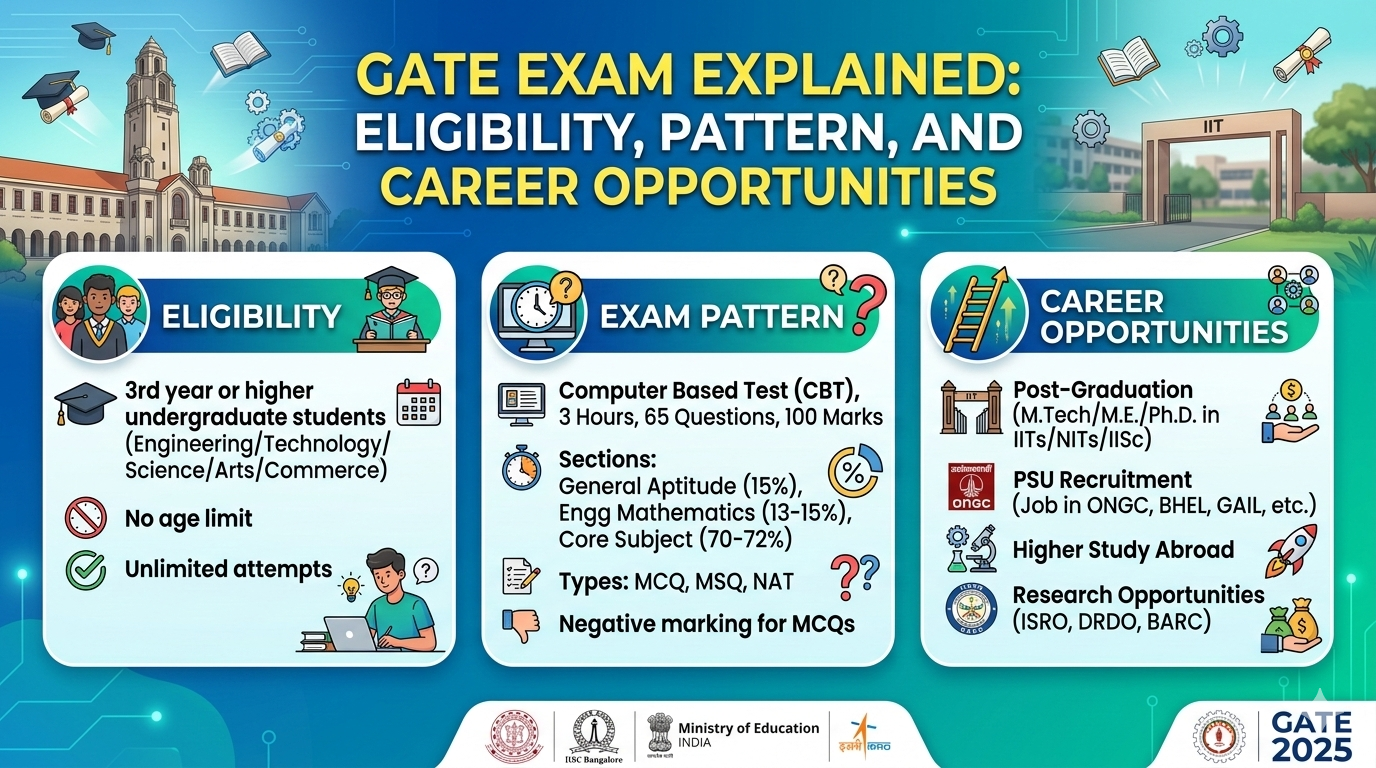
One of the best things about GATE is its inclusivity. There is no upper age limit and no restriction on the number of attempts.
- Educational Qualification: You must be in your 3rd year or higher of an undergraduate degree or have already completed a government-approved degree program.
- Diverse Fields: While “Engineering” is in the name, students from Science, Commerce, and Humanities (like Economics, Psychology, and Linguistics) are also eligible for specific papers.
Why Should You Take the GATE Exam?
Cracking GATE opens several doors that are otherwise difficult to access:
- Post-Graduation (M.Tech/M.E./Ph.D.): Secure admission to premier institutes like the IITs, NITs, and IISc.
- Public Sector Undertakings (PSUs): Top government companies like ONGC, GAIL, IOCL, and BHEL use GATE scores to recruit Graduate Engineer Trainees. These are high-paying, stable “Class A” government jobs.
- Financial Assistance: Students admitted to M.Tech programs via GATE are eligible for a monthly stipend (currently around ₹12,400).
- Study Abroad: Your GATE score is recognized by some elite international universities, such as the National University of Singapore (NUS) and Nanyang Technological University (NTU).
- Research Opportunities: Organizations like BARC, ISRO, and DRDO often consider GATE scores for research-based positions.
Exam Pattern at a Glance
The exam is a Computer-Based Test (CBT) that lasts for 3 hours. It is known for testing conceptual clarity rather than rote memorization.
| Features | Details |
| Total Marks | 100 |
| Total Questions | 65 |
| Question Types | Multiple Choice (MCQ), Multiple Select (MSQ), Numerical Answer type (NAT) |
| Sections | General Aptitude (15%), Engineering Maths(13-15%), Core Subjects (70-72%) |
| Negative Markings | Only for MCQs (1/3 for 1-Mark,2/3 for 2 – Mark);No Negative marks for MSQ/NAT |
How to Start Preparing:
- Know Your Syllabus: Every subject (e.g., Computer Science, Mechanical, Civil) has a specific syllabus. Download it from the official website (currently managed by IIT Guwahati for 2026).
- Focus on Aptitude: The General Aptitude section is 15 marks and is often the easiest way to boost your score.
- Practice PYQs: Previous Year Questions (PYQs) are the “holy grail” of GATE preparation. They help you understand the depth and style of questions asked.
- Use a Virtual Calculator: You aren’t allowed a physical calculator. Practice using the official GATE virtual calculator software to save time during the actual exam.